|
| |
 |
We offer source-identified, native seed and plants. In 2001 we began to propagate native plants for our own restoration work as well as other projects occurring in the Willamette Valley. Since then our propagation effort has expanded to over 85 species of native grasses, sedges, rushes and wildflowers for seed and plants, with more coming on-line every year. .
Our key focus has been to increase the number of forb species commercially available. Native grasses are only part of what makes successful prairie habitat. Native bunchgrasses provide structure for ground-nesting birds and space for forbs. The forb component is vital for providing food for our native pollinators and other insects. Increasing the insects will, in turn, increase bird abundance and diversity.
|
| |
 |
Native Seed and Seed Mix
We guarantee that you will receive high quality, viable seed every time you order from Heritage Seedlings. Our seed is tested by an independent lab for purity and germination using standard procedures of the Association of Official Seed Analysts.
All of our seed is sold "PLS" - Pure Live Seed. A pound of "PLS" is the actual weight of seed required to equal one pound of 100% pure, viable seed. This is calculated based upon current purity and germination tests. So although seed you order and prices are per PLS pound the actual weight will be more than the PLS pounds of seed ordered.
Calculations |
Please browse through our list of native plants. All are native to the Willamette Valley, and many occur in other western states (consult your local flora). Photos of individual species are shown below on this page. For photos and information about our restoration progress, see our Stewardship page.
Note: All the species on our seed list can be contract grown as plugs, bare root divisions, or field-grown seedlings. Please call our office for details.
To view our seed and plant lists below you will need Adobe Acrobat Reader®. Click here to download this free program.
For a printable version of our current pricing by species, click here
For current seed mixes, click here.
NEW: DISCOUNT BULK PRICING!
To order, please give us a call (503-585-9835), or send us an email at sales@heritageseedlings.com. Our minimum purchase is $250 per order for seed. We add a $2.00 packing fee for each item ordered in quantities less than one pound.
|
| |
 |
These links may help you establish a successful native plant community using either seed or plants. We hope you find them useful. |
| |
 |
Click below to view pictures of selected plants (P = plant, F = flower): |
| |
 |
An ecoregion is "a relatively large area of land or water that contains a geographically distinct assemblage of natural communities." [World Wildlife Fund]
We propagate numerous species native to the Willamette Valley ecoregion.
Willamette Valley Ecoregion
Before European settlement in the mid-1800's, the Willamette Valley was a mosaic of rolling prairies and oak/pine savannas, oak woodlands, wetlands, and occasional conifer stands. Seasonal flooding and frequent, low-intensity fires set by Native Americans played a major role maintaining this landscape. They used fire to foster lush regrowth of prairie grasses that sustained game, wild food plants such as camas, and to keep the landscape more open for hunting.
|
Since European settlement, agriculture and forestry practices, fire suppression, and development have irrevocably altered this original habitat. The advocate organization "Defenders of Wildlife" estimates that oak woodlands and savannas have been reduced by 80%, wetlands by 87%, bottomland hardwood forests by 70%, and native prairie by over 98%. Much that remains is severely degraded due to aggressive encroachment by invasive plants and Douglas fir. Degraded habitat has caused the decline of numerous wildlife species, including Oregon's own state bird, the western meadowlark.
To learn more about restoration of these important habitats, click on Stewardship at the top of the page.
The habitat descriptions below were based upon descriptions developed by The Nature Conservancy. (Note: Abbreviations are used in our list of Seed for Sale.)
| |
 |
Herbaceous Balds and Bluffs [HB] Herbaceous balds and bluffs occur in the driest environmental settings that support continuous vegetation: generally south- to west-facing slopes on shallow or sandy/gravelly soils. They typically occur as isolated sites within a forest matrix or on coastal bluffs. Burning by Native Americans was probably an important "management" factor on most of these sites, and some of them are threatened by invasion of trees due to modern-day fire suppression. Vegetation is dominated by perennial bunchgrasses, forbs(herbaceous flowering plants that are neither grasses, rushes or sedges), and mosses. Scattered trees, especially Quercus garyana (Oregon white oak), Arbutus menzeisii (madrone), and Pseudotsuga menziesii (Douglas fir) are often present on the fringes. |
| |
| |
 |
Oregon White Oak Woodlands [OW] This system is associated with dry sites and/or frequent pre-settlement fires. In the Willamette Valley, soils are mesic (sites characterized by intermediate moisture conditions neither decidedly wet nor decidedly dry), yet well-drained. In the absence of fire, succession tends to favor increased shrub dominance in the understory and greater tree density. The vegetation is a woodland dominated by deciduous broadleaf trees, mostly Quercus garryana. Co-dominance by the evergreen conifer Pseudotsuga menziesii is common, the end result being conversion to a conifer forest. |
| |
| |
| |
 |
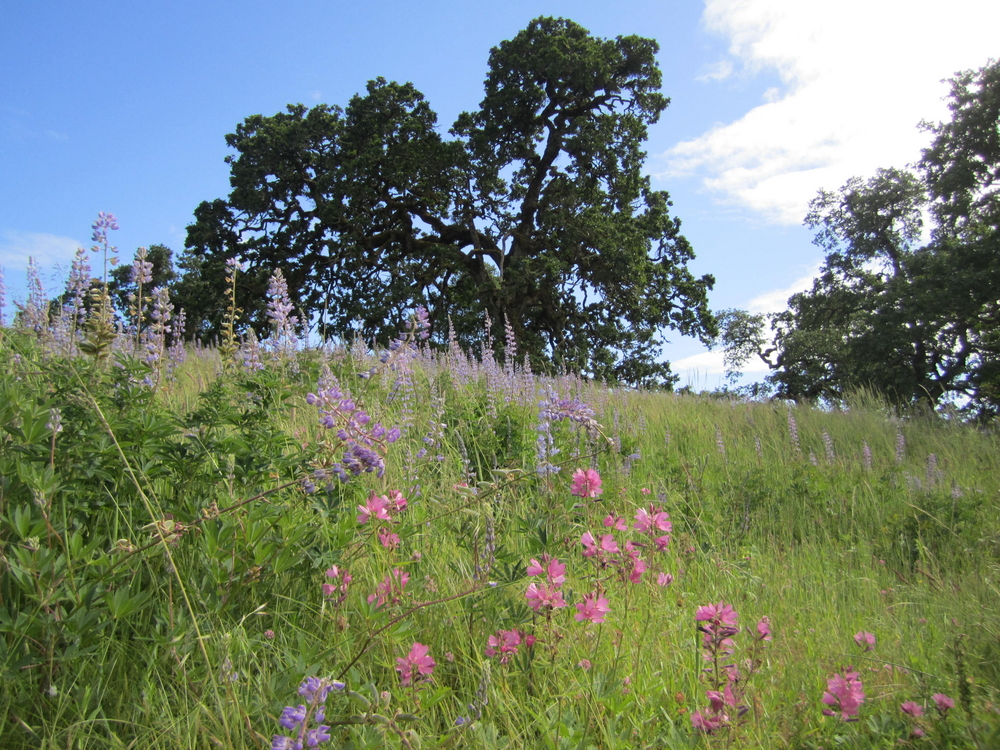
Upland Prairies and Savannas [UP] This ecosystem formed a complex mosaic of varying patch sizes of open grasslands often associated with low-density tree cover (5-30%) over much of the Willamette Valley. It occurs on well-drained soils and was maintained by the Native American practice of setting frequent low-intensity fires. With fire suppression or in abandoned pastures, many such areas have succeeded to forest. The dominant vegetation of these native grasslands were perennial bunchgrasses such as Festuca roemeri (Roemer's fescue) and Danthonia californica (California oatgrass), with abundant and diverse herbaceous plants. Scattered, open-growth trees such as Quercus garryana, Pseudotsuga menziesii, or Pinus ponderosa (ponderosa pine) within the grassland characterize a savanna. Uncommon now, such savannas once covered about 1/3 of the Willamette Valley. |
| |
| |
|
|
Vernal Pools [VP]
Vernal pools are a component of wet prairies (see below) characterized by freshwater inundation for much of the winter and spring, followed by drought conditions during the summer. They are found in isolated small depressions with no inflow or outflow, and a restrictive subsurface soil layer (clay or bedrock). Vegetation is dominated primarily by annual forbs. |
| |
 |
Wet Prairies [WP] Wet prairies covered large areas of the Willamette Valley where they were maintained by a combination of wetland soil hydrology and regular burning. These are high nutrient wetlands that are temporarily or seasonally flooded. They have been reduced to tiny fragments of their former range. They are dominated primarily by grasses, sedges and rushes, especially Deschampsia cespitosa (tufted hairgrass), Danthonia californica, and Carex spp. |
|